
KPV: Discovery and Research History
How KPV (Lys-Pro-Val) emerged from decades of alpha-MSH research: the parent molecule and POMC biology, the Lipton-Catania neuroimmunomodulation program, the structure-activity work that isolated the C-terminal tripeptide, and later transporter and delivery studies.

For research use only. Not for human consumption. This article is educational reference material. It is not medical advice and is not a recommendation to use any substance.
Introduction
KPV is the tripeptide Lys-Pro-Val, corresponding to residues 11 through 13 of alpha-melanocyte-stimulating hormone (alpha-MSH). Unlike compounds with a single synthesis paper or a named inventor, KPV has no discrete discovery moment. Its scientific identity emerged gradually, as investigators dissected the alpha-MSH molecule to determine which of its functions depended on classical melanocortin-receptor binding and which did not. This article traces that lineage across four overlapping research eras: the characterization of alpha-MSH and its precursor protein, the neuroimmunomodulation program of the 1980s and 1990s, the structure-activity work that isolated the C-terminal tripeptide, and the delivery-focused research that followed.
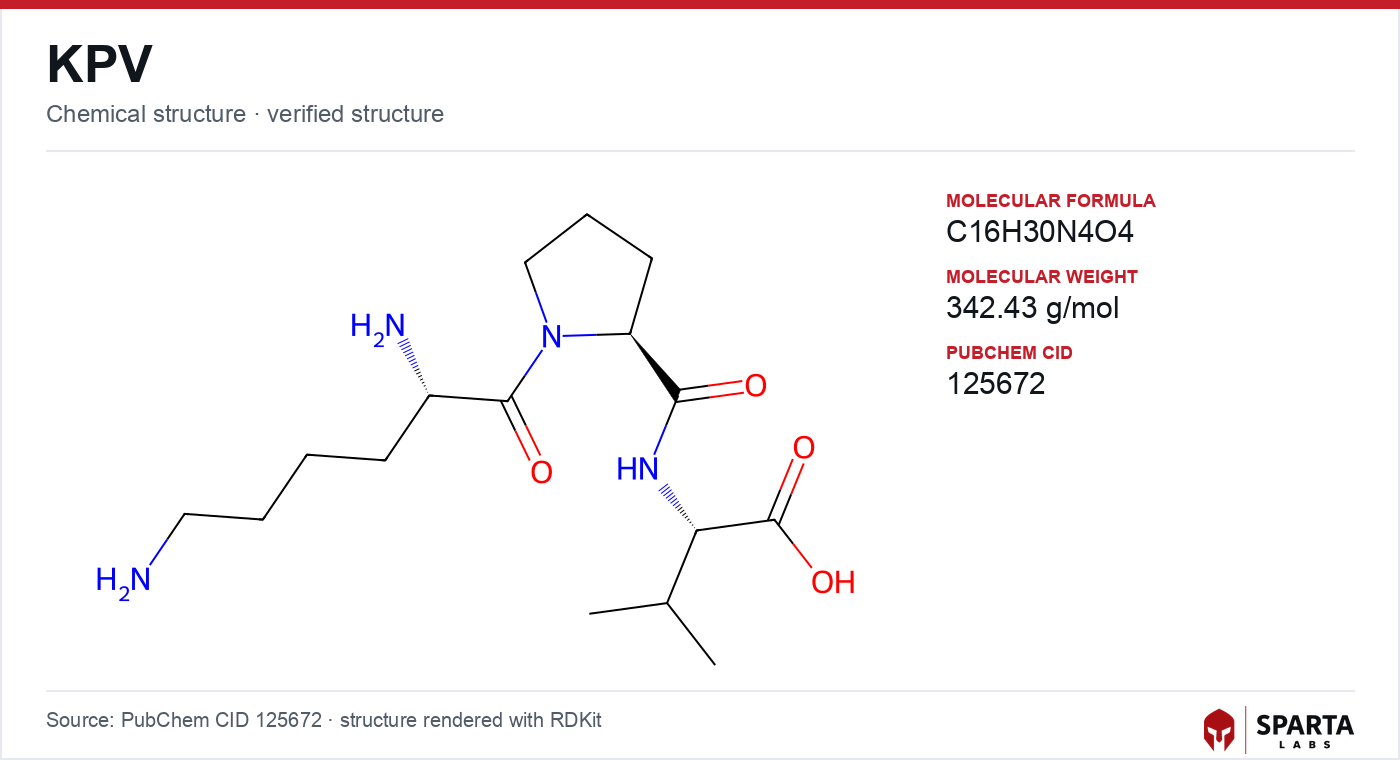
Figure: chemical structure of KPV.
The Parent Molecule: alpha-MSH and POMC (1950s–1980s)
The story of KPV begins with alpha-MSH, a 13-residue peptide first isolated from pituitary extracts in the mid-twentieth century and initially studied through melanotropic assays that tracked pigment dispersion in amphibian skin. Peptide chemistry of the 1960s and 1970s established the amino-acid sequence of human alpha-MSH and identified its N-terminal acetylation and C-terminal amidation as features of the biologically active form.
A conceptual shift followed the cloning of the proopiomelanocortin (POMC) gene at the turn of the 1980s. POMC was recognized as the common precursor for alpha-MSH, adrenocorticotropic hormone (ACTH), beta-endorphin, and other bioactive fragments. Documentation of POMC and alpha-MSH expression outside the pituitary, including in hypothalamic neurons, skin keratinocytes, and immune cells, reframed the peptide as a component of a distributed neuroendocrine system rather than a pigmentation signal alone. That reframing set the stage for the immunological research that would eventually surface KPV as a distinct entity. The receptor-binding branch of this same molecule, centered on the His-Phe-Arg-Trp pharmacophore, is discussed in the Melanotan-2 research overview.
The Neuroimmunomodulation Program (1980s–1990s)
The anti-inflammatory properties of alpha-MSH became a sustained research theme through the work of James M. Lipton, Anna Catania, and collaborators. A 1986 report by Cannon, Tatro, Reichlin, and Dinarello demonstrated that alpha-MSH inhibited the immunostimulatory and inflammatory actions of interleukin-1 (IL-1) in murine thymocyte and in vivo systems, establishing that a melanocortin peptide could modulate cytokine-driven inflammatory signaling [1].
Findings from research models do not establish safety or efficacy in humans. Sparta Labs makes no claims about the use of this compound.
Over the following decade, this line of work characterized alpha-MSH across a range of experimental inflammation models. The 1993 Endocrine Reviews synthesis by Catania and Lipton organized the accumulating evidence for alpha-MSH as a modulator of host reactions, spanning fever, cytokine biology, and multiple inflammatory paradigms [2]. Their 1997 Immunology Today review formally described alpha-MSH as a neuroimmunomodulator, a classification that captured the convergence of central nervous-system neuropeptide biology with peripheral immune regulation [3]. These review articles functioned as an organizing framework that pointed later investigators toward the question of which structural region of the peptide carried the anti-inflammatory activity. A comparable fragment-dissection history unfolded for the copper-binding tripeptide GHK, recounted in the GHK-Cu discovery and research history.
Isolating the C-Terminal Tripeptide
The 13-residue alpha-MSH sequence contains two pharmacologically distinct regions. The central His-Phe-Arg-Trp motif at positions 6 through 9 mediates high-affinity melanocortin-receptor binding and pigmentary effects. The C-terminal Lys-Pro-Val segment at positions 11 through 13 became the focus of a separate inquiry once investigators observed that the anti-inflammatory activity did not track cleanly with receptor-binding potency.
A structural observation motivated much of this work: the KPV sequence resembles the C-terminal tripeptide of interleukin-1 beta, prompting hypotheses that this region of alpha-MSH might interact with the IL-1 signaling system independently of melanocortin receptors. Getting, Schioth, and Perretti published in 2003 the study that most clearly resolved KPV as a discrete pharmacological entity [4]. Using a murine crystal-induced peritonitis model together with in vitro macrophage assays, the authors reported that KPV retained in vivo anti-inflammatory activity on certain endpoints comparable to the parent peptide, and that these effects were not abolished by melanocortin MC3 and MC4 receptor antagonists. This receptor-independence finding distinguished KPV from the receptor-mediated branch of alpha-MSH pharmacology and framed the questions that later mechanistic studies addressed. Those receptor-level distinctions are examined further in the KPV mechanism of action article.
Regulatory Status and the Broader Melanocortin Class
Neither KPV nor alpha-MSH has received FDA approval as a therapeutic agent for any indication, and the tripeptide remains within the preclinical research domain. The wider melanocortin field has nonetheless produced approved pharmaceuticals through its receptor-mediated branch: bremelanotide (Vyleesi), a melanocortin-4 receptor agonist, was approved by the FDA in 2019. That approval illustrates the translational trajectory of the receptor-binding arm of melanocortin biology, which is chronicled in the PT-141 (Bremelanotide) discovery and regulatory history. KPV belongs to the complementary, receptor-independent arm and has not followed a comparable regulatory path.
Later Research: Transporters and Delivery Systems
After the 2003 structure-activity work, KPV research through the following decade advanced along mechanistic and delivery lines. Dalmasso and colleagues reported in 2008 that the intestinal peptide transporter PepT1 mediated cellular uptake of KPV in models of intestinal inflammation, introducing a transporter-based route of cellular entry into the research conversation [5]. Land's 2012 study in human bronchial epithelial cells examined the molecular basis of KPV's reported NF-kappaB inhibitory activity and described a contributing role for MC3R agonism in that specific system [6].
Delivery methodology advanced further with the work of Xiao and colleagues, who reported in 2017 that hyaluronic-acid-functionalized nanoparticles could deliver KPV to inflamed colonic tissue in murine models, extending research beyond transporter-dependent uptake toward engineered carrier systems [7]. Taken together, these mechanistic and delivery investigations position KPV as an active preclinical research topic within melanocortin-complementary immunomodulation. Synthesis routes and analytical verification standards for the research compound are detailed in the KPV sourcing and quality reference, and research-grade material is catalogued on the KPV product page.
References
-
Cannon JG, Tatro JB, Reichlin S, Dinarello CA. Alpha melanocyte stimulating hormone inhibits immunostimulatory and inflammatory actions of interleukin 1. J Immunol. 1986;137(7):2232-2236. PMID: 3489761. PubMed
-
Catania A, Lipton JM. Alpha-melanocyte stimulating hormone in the modulation of host reactions. Endocr Rev. 1993;14(5):564-576. PMID: 8262006. DOI: 10.1210/edrv-14-5-564. PubMed
-
Lipton JM, Catania A. Anti-inflammatory actions of the neuroimmunomodulator alpha-MSH. Immunol Today. 1997;18(3):140-145. PMID: 9078687. DOI: 10.1016/s0167-5699(97)01009-8. PubMed
-
Getting SJ, Schioth HB, Perretti M. Dissection of the anti-inflammatory effect of the core and C-terminal (KPV) alpha-melanocyte-stimulating hormone peptides. J Pharmacol Exp Ther. 2003;306(2):631-637. PMID: 12750433. DOI: 10.1124/jpet.103.051623. PubMed
-
Dalmasso G, Charrier-Hisamuddin L, Nguyen HTT, Yan Y, Sitaraman S, Merlin D. PepT1-mediated tripeptide KPV uptake reduces intestinal inflammation. Gastroenterology. 2008;134(1):166-178. PMID: 18061177. DOI: 10.1053/j.gastro.2007.10.026. PubMed
-
Land SC. Inhibition of cellular and systemic inflammation cues in human bronchial epithelial cells by melanocortin-related peptides: mechanism of KPV action and a role for MC3R agonists. Int J Physiol Pathophysiol Pharmacol. 2012;4(2):59-73. PMID: 22837805. PubMed
-
Xiao B, Xu Z, Viennois E, Zhang Y, Zhang Z, Zhang M, Han MK, Kang Y, Merlin D. Orally targeted delivery of tripeptide KPV via hyaluronic acid-functionalized nanoparticles efficiently alleviates ulcerative colitis. Mol Ther. 2017;25(7):1628-1640. PMID: 28143741. DOI: 10.1016/j.ymthe.2016.11.020. PubMed
Disclaimer. Statements in this article have not been evaluated by the Food and Drug Administration. This compound is not intended to diagnose, treat, cure, or prevent any disease. Sparta Labs sells research-use-only materials. Content is provided for educational and informational purposes only and does not constitute medical advice. Consult a qualified medical professional for any health concerns.
Frequently asked questions
When was KPV discovered?
KPV has no single discovery date. It emerged from decades of research on alpha-MSH biology rather than from one synthesis paper. The anti-inflammatory activity of alpha-MSH was documented as early as 1986, and Getting, Schioth, and Perretti resolved the C-terminal tripeptide KPV as a distinct pharmacological entity in a 2003 study.
How did KPV become recognized as a separate compound from alpha-MSH?
Investigators dissecting the 13-residue alpha-MSH sequence found that its anti-inflammatory activity did not track with melanocortin-receptor binding. A 2003 study reported that the C-terminal Lys-Pro-Val fragment retained anti-inflammatory activity in a murine peritonitis model even when MC3 and MC4 receptors were blocked, distinguishing KPV from the receptor-mediated branch of alpha-MSH pharmacology.
What is the regulatory status of KPV?
Neither KPV nor alpha-MSH has received FDA approval as a therapeutic agent for any indication, and the tripeptide remains within the preclinical research domain. By contrast, the receptor-mediated branch of the melanocortin class produced an approved product, bremelanotide (Vyleesi), in 2019.
How does KPV relate to bremelanotide within melanocortin research?
Both trace back to melanocortin peptide science, but they represent different branches of it. Bremelanotide is a melanocortin-4 receptor agonist, illustrating the receptor-mediated arm of the field. KPV is associated with receptor-independent activity, placing it in the complementary arm that has not followed the same regulatory path.